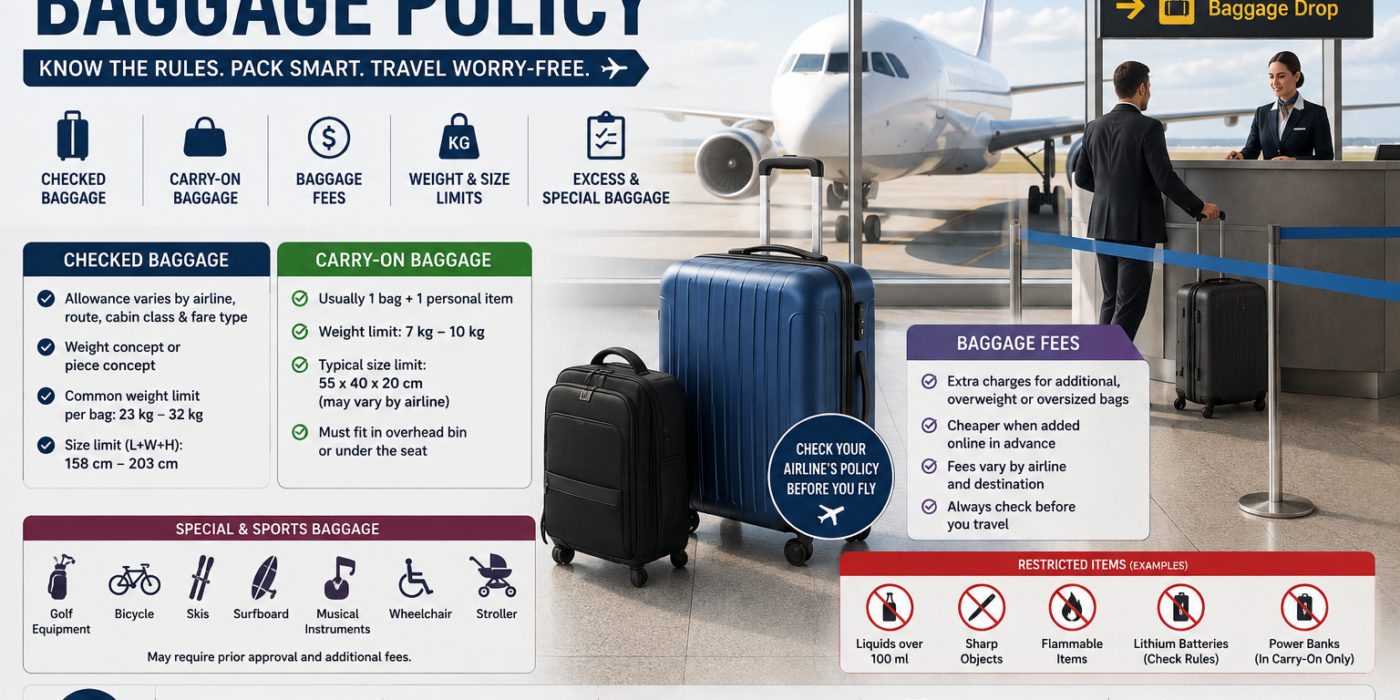
What Is an Airline Baggage Policy?
An airline baggage policy explains how much luggage a passenger can take on a flight, what size and weight limits apply, which items are allowed, and what charges may apply when the free allowance is exceeded.
Baggage rules are not the same for every airline. They can vary according to the airline, route, fare type, cabin class and frequent-flyer status. IATA specifically advises travelers to check the rules that apply to their individual trip directly with the airline.
Understanding the policy before you travel can help you avoid unexpected baggage fees, repacking at the airport and delays during check-in.
Read More: Royal Jordanian Baggage Allowance
Top 5 Airline Baggage Policy Rules
1. Check Your Free Baggage Allowance
The first thing to check is your airline baggage allowance.
Some airlines include checked baggage with the ticket, while others charge separately. The allowance can also change according to the fare you purchase.
For example, a basic or promotional fare may include little or no checked baggage, while a higher fare may include one or more checked bags.
Airlines can use either a weight concept or a piece concept for checked luggage. Under a weight concept, your ticket may specify a total amount such as 20 kg, 30 kg or 40 kg. Under a piece concept, the ticket specifies the number of bags and the maximum weight allowed for each bag.
Before packing, check your booking confirmation for:
- Number of checked bags
- Maximum weight
- Maximum dimensions
- Cabin baggage allowance
- Personal-item allowance
- Applicable baggage fees
2. Understand the Checked Baggage Policy
The checked baggage policy applies to luggage that you hand over at the airport check-in counter or baggage-drop facility.
Checked luggage is placed in the aircraft’s baggage compartment and is collected at your destination.
The amount of checked luggage you can take depends on your airline and ticket. The FAA notes that airlines can limit baggage based on either the number of pieces or the total weight, depending on the airline, trip and origin or destination.
Common checked-bag requirements include:
- Maximum weight per bag
- Maximum total baggage weight
- Maximum external dimensions
- Number of free bags
- Additional-bag charges
- Overweight-bag charges
- Oversized-bag charges
A standard suitcase may be accepted only when it satisfies both weight and size requirements.
For example, a bag can be light enough but still too large to qualify as standard checked baggage.
3. Know Your Carry-On Baggage Rules
The carry-on baggage rules apply to luggage that you take into the aircraft cabin.
Airlines commonly specify:
- Maximum number of cabin bags
- Maximum cabin-bag weight
- Maximum length
- Maximum width
- Maximum height
The exact limits vary by airline. The FAA recommends checking directly with your airline because individual carriers may have stricter carry-on requirements.
Many airlines also allow a smaller personal item, such as:
- Handbag
- Small backpack
- Laptop bag
- Small camera bag
The personal item normally needs to fit underneath the seat in front of you.
Important Tip
Do not assume that a suitcase advertised as “carry-on size” will be accepted by every airline. Measure the bag, including wheels and handles, and compare it with the airline’s current requirements.
Airline Baggage Size Limits
Baggage dimensions are normally calculated by measuring the suitcase’s:
Length + Width + Height
Some airlines publish a maximum linear dimension, while others specify exact dimensions.
The FAA says that the maximum carry-on size for many airlines is around 45 linear inches, but it also stresses that travelers should check the specific airline’s rules.
This is particularly important when traveling with:
- Large suitcases
- Sports equipment
- Musical instruments
- Strollers
- Wheelchairs
- Oversized boxes
If your luggage exceeds the standard size, the airline may classify it as oversized baggage and charge an additional fee.
Airline Baggage Weight Limit
The baggage weight limit is one of the most important parts of any airline luggage policy.
Weight limits can apply to:
- Checked baggage
- Cabin baggage
- Personal items
- Special equipment
A passenger with a 30 kg total allowance may be allowed to divide that weight across multiple bags, depending on the airline’s rules.
However, some airlines have a maximum individual-bag limit. Therefore, you should not assume that a total allowance can be placed into one suitcase.
Best Packing Method
Before leaving home:
- Weigh every suitcase.
- Check the airline’s maximum weight.
- Check the suitcase dimensions.
- Redistribute items if necessary.
- Keep important documents and valuables in your cabin bag.
A small luggage scale can be extremely useful for avoiding overweight baggage charges.
Airline Baggage Fees
Airline baggage fees can significantly increase the total cost of a flight.
The actual cost may depend on:
- Airline
- Route
- Fare type
- Number of bags
- Bag weight
- Bag dimensions
- When you pay
- Frequent-flyer status
Some airlines offer lower prices when baggage is purchased online before the airport. Current 2026 travel guidance also shows that baggage fees can vary substantially between airlines and that some carriers charge for carry-on or checked luggage depending on the fare.
For this reason, travelers should compare the total flight price including baggage, rather than comparing ticket prices alone.
Example
Airline A:
- Ticket: $200
- Checked bag: $50
Total: $250
Airline B:
- Ticket: $220
- Checked bag: Free
Total: $220
The apparently cheaper ticket is not always the cheaper journey.
Excess Baggage Allowance
If you travel with more luggage than your free allowance, you may need to pay for excess baggage.
Excess baggage can include:
- Additional bags
- Overweight bags
- Oversized bags
- Special equipment
Some airlines sell extra baggage online before departure. Others allow passengers to pay at check-in.
Buying extra baggage in advance can sometimes be cheaper than paying at the airport, although the exact savings depend on the airline and route.
Always check the airline’s official website or booking system for the current price.
Overweight and Oversized Baggage
Overweight baggage means the bag exceeds the airline’s permitted weight.
Oversized baggage means the bag exceeds the airline’s permitted dimensions.
These are different charges, and a suitcase can sometimes be both overweight and oversized.
For example:
- Allowed weight: 23 kg
- Actual weight: 28 kg
This may result in an overweight charge.
Likewise:
- Allowed dimensions: 158 cm total
- Actual dimensions: 175 cm total
This may result in an oversized-baggage charge.
Check both measurements before traveling.
Airline Baggage Policy for International Flights
The international flight baggage allowance can be different from domestic baggage rules.
International tickets may use a piece-based system, a weight-based system or fare-specific allowances.
Connecting flights also require extra attention. If more than one airline operates your itinerary, baggage rules may not be identical across every flight.
IATA notes that baggage policies can differ across interline itineraries and that airlines are responsible for establishing their own baggage allowances.
Before an International Flight
Check:
- First airline
- Connecting airline
- Final destination
- Fare type
- Number of bags
- Weight per bag
- Cabin baggage
- Special baggage requirements
This is especially important when your journey includes multiple airlines.
What Can You Put in Checked Baggage?
Many normal clothing and personal items can be placed in checked luggage, but some products are restricted or prohibited.
Examples of items that may require special handling include:
- Lithium batteries
- Power banks
- Certain chemicals
- Flammable materials
- Some sporting equipment
- Certain medical devices
IATA advises passengers to keep lithium-powered devices and spare batteries in hand baggage, while the FAA provides specific PackSafe guidance for dangerous goods and batteries.
Always check the airline and relevant aviation-security rules before packing unusual items.
What Should You Keep in Your Carry-On?
Your cabin baggage should contain items you may need during the journey.
Recommended items include:
- Passport
- Travel documents
- Wallet
- Phone
- Laptop
- Chargers
- Important medication
- Valuable electronics
- Essential personal items
If your carry-on is unexpectedly checked at the gate, spare batteries and lithium-battery-powered devices should be removed and kept in the cabin where required.
Baggage Policy for Families and Infants
Families should check whether the airline provides special allowances for:
- Infants
- Children
- Strollers
- Car seats
- Baby food
- Wheelchairs
Policies differ significantly between airlines.
Some carriers allow a stroller to be checked without using part of the normal baggage allowance, while others may apply specific conditions.
Always check the airline’s rules before arriving at the airport.
Special and Sports Baggage
Airlines may have separate rules for:
- Golf clubs
- Bicycles
- Surfboards
- Skis
- Musical instruments
- Large cameras
- Wheelchairs
- Sporting equipment
These items may have special size, packaging and fee requirements.
If you are carrying expensive or unusual equipment, contact the airline before your trip rather than assuming it will be accepted as a standard suitcase.
How to Avoid Airline Baggage Fees
You can reduce the chance of extra charges by following these simple tips:
1. Choose the Right Fare
Compare fares based on the baggage they include.
2. Weigh Your Bags at Home
Never wait until the airport to discover that your suitcase is overweight.
3. Measure Your Suitcase
Check length, width and height.
4. Purchase Extra Baggage Early
If you know you need additional luggage, compare the airline’s advance-purchase price with the airport price.
5. Use Your Cabin Allowance Wisely
Put permitted lightweight essentials in your carry-on instead of your checked bag.
6. Check Your Ticket
Your booking confirmation is one of the best places to find the allowance for your specific journey.
Airline Baggage Policy Checklist
Before leaving for the airport, use this checklist:
☐ Check your baggage allowance
☐ Check the number of free checked bags
☐ Check the weight limit
☐ Measure your suitcase
☐ Check cabin-bag dimensions
☐ Check personal-item rules
☐ Review restricted items
☐ Check excess baggage prices
☐ Confirm connecting-airline rules
☐ Keep passport and valuables in your cabin bag
This simple checklist can prevent many common baggage problems.
Frequently Asked Questions
What is an airline baggage policy?
An airline baggage policy explains the amount, size and weight of luggage passengers can take, along with fees and restrictions for additional or special baggage.
How much checked baggage can I take?
There is no universal amount. Your allowance depends on the airline, fare, cabin class, route and sometimes frequent-flyer status.
What is carry-on baggage?
Carry-on baggage is luggage that you take into the aircraft cabin rather than checking into the aircraft’s baggage compartment.
What is excess baggage?
Excess baggage is luggage that exceeds the free allowance provided with your ticket. The airline may charge additional fees.
Can baggage rules change between airlines?
Yes. Every airline can establish its own baggage allowance, and rules can also vary according to fare, route and cabin class.
Is a laptop allowed in checked baggage?
Airlines and aviation authorities generally have specific rules for lithium-battery-powered devices. IATA advises keeping lithium-powered devices and spare batteries in hand baggage, and passengers should check the applicable airline rules.
Final Thoughts
A clear understanding of the airline baggage policy can make your journey easier and help you avoid unnecessary fees. The most important things to check are your checked baggage allowance, carry-on baggage rules, baggage weight limit, luggage size and excess baggage fees.
Remember that there is no single baggage policy for every airline. Rules can vary according to the airline, route, fare type and cabin class. IATA and the FAA both recommend checking the specific airline’s requirements before packing.
Before every flight, check your booking, weigh your luggage and measure your bags. If you are traveling with multiple airlines, verify the baggage rules for the complete itinerary.
Top 5 Things to Remember
- Always check your airline’s exact baggage allowance.
- Know both checked and carry-on baggage limits.
- Weigh and measure your luggage before going to the airport.
- Check excess and overweight baggage fees in advance.
- Review special-item and restricted-item rules before packing.