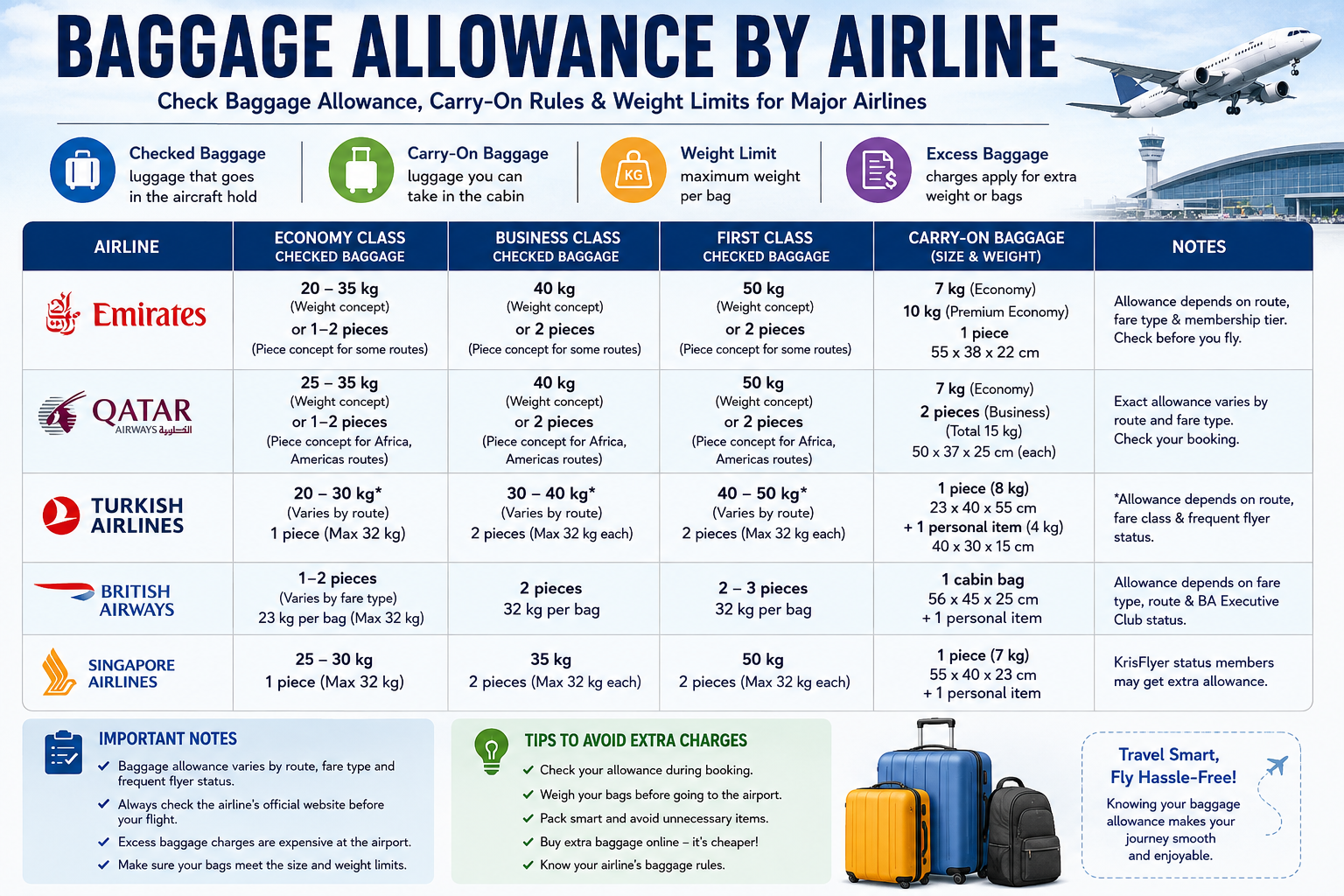
Understanding baggage allowance by airline is one of the most important parts of planning an international trip. Every airline has its own rules for checked baggage, carry-on bags, weight limits, dimensions, and excess baggage fees. Your allowance can also change depending on your destination, fare type, cabin class, frequent-flyer status, and ticket conditions.
Knowing your airline’s baggage policy before reaching the airport can help you avoid unexpected fees and delays. In this guide, we explain how airline baggage allowance works and compare some of the major international airlines.
Read More:Airport Lounge Access Guide
What Is Airline Baggage Allowance?
Airline baggage allowance refers to the amount and type of luggage a passenger can take on a flight without paying additional baggage charges.
There are usually two main categories:
- Checked baggage
- Carry-on or cabin baggage
Checked bags are handed to the airline at the check-in counter and transported in the aircraft’s hold. Carry-on baggage stays with you in the cabin and must meet the airline’s size and weight requirements.
Some airlines use a weight-based system, while others use a piece-based system. Emirates, for example, uses the weight concept on many routes and the piece concept on flights to and from certain regions, including the Americas and Africa.
Baggage Allowance by Airline
Baggage rules can differ considerably between airlines. Here are some popular international carriers and examples of their baggage policies.
Emirates Baggage Allowance
Emirates offers different allowances depending on the fare, cabin class, and route.
Under its weight concept, Economy Class fares can have allowances ranging from 20 kg to 35 kg, while Premium Economy has 35 kg, Business Class has 40 kg, and First Class has 50 kg. On piece-concept routes, the allowance is based on the number of bags and the permitted weight per bag.
For cabin baggage, Emirates generally allows Economy passengers one carry-on bag up to 7 kg, with maximum dimensions of 55 × 38 × 22 cm. Premium Economy passengers can carry up to 10 kg, while Business and First Class have different cabin-baggage arrangements.
This makes Emirates an important airline to check when comparing international baggage allowance.
Qatar Airways Baggage Allowance
Qatar Airways also bases checked baggage allowances on the route and cabin class.
Economy fares can have different allowances depending on the fare type. On many routes, Economy allowances range from 25 kg to 35 kg, while flights to or from Africa or the Americas can use a piece-based allowance. Business Class can have 40 kg on weight-based routes, and First Class can have 50 kg.
Qatar Airways’ standard Economy cabin allowance includes one carry-on piece up to 7 kg, while Business Class passengers can generally carry two cabin pieces with a combined weight limit.
Passengers should check their booking because the exact allowance is determined by the route and fare.
Turkish Airlines Baggage Allowance
Turkish Airlines has specific rules for both cabin and checked baggage.
For Economy Class, the airline allows one cabin bag with maximum dimensions of 23 × 40 × 55 cm and a maximum weight of 8 kg. Passengers can also carry one personal item measuring up to 40 × 30 × 15 cm and weighing up to 4 kg.
Business Class passengers can carry two cabin bags, each weighing up to 8 kg, with a combined limit of 16 kg, plus a personal item.
For checked baggage, the allowance depends on the route and fare. Turkish Airlines also states that a single piece of baggage cannot exceed 32 kg.
British Airways Baggage Allowance
British Airways uses different baggage allowances depending on the cabin, ticket, and membership status.
Its standard cabin baggage policy includes one cabin bag measuring up to 56 × 45 × 25 cm and one smaller handbag or backpack.
Checked baggage can also vary by fare and cabin class. Some eligible passengers receive multiple checked bags, with certain allowances permitting bags up to 32 kg each. British Airways also notes that partner-airline baggage rules can differ, so passengers traveling on connecting itineraries should check the applicable allowance.
Checked Baggage vs Carry-On Baggage
Understanding the difference between checked and cabin baggage is essential.
Checked baggage is stored in the aircraft’s cargo hold. It usually has a higher weight allowance but may have additional charges depending on your ticket.
Carry-on baggage is taken into the cabin. Because overhead-bin space is limited, airlines normally impose strict size and weight limits.
Your ticket may include one checked bag, multiple checked bags, or no checked baggage at all. Low-cost and basic economy fares often have more restrictive baggage conditions.
What Is Excess Baggage?
Excess baggage means luggage that exceeds the allowance included with your ticket.
This can happen when:
- Your bag is overweight.
- You have more bags than your ticket allows.
- Your bag exceeds the permitted dimensions.
- Your fare does not include checked baggage.
Airlines may charge an excess baggage fee based on weight, number of pieces, route, or a combination of these factors.
If you already know you will need additional luggage, buying extra baggage before arriving at the airport can sometimes be cheaper. Emirates, for example, offers advance-purchase options for additional baggage on eligible journeys.
Airline Baggage Allowance for Economy Class
Economy Class baggage allowances vary significantly between airlines.
Some Economy fares include a checked bag, while others may charge separately. Even within the same airline, different Economy fare types can have different allowances.
For this reason, passengers should never assume that every Economy ticket includes the same amount of luggage.
Always look at the baggage information shown on your booking confirmation or the airline’s official baggage calculator.
International Baggage Allowance
International baggage allowance is often more complicated because rules can depend on the origin, destination, connecting flights, and airline combinations.
For example, Emirates uses different baggage concepts depending on the route, while Qatar Airways also changes allowances according to destination and cabin class.
If your journey involves multiple airlines, check which carrier’s baggage rules apply. The airline operating the first flight, the marketing carrier, or the rules associated with the ticket can affect your allowance.
How to Avoid Extra Baggage Fees
There are several simple ways to reduce the risk of unexpected baggage charges.
Check Your Ticket
Your booking confirmation normally shows your included baggage allowance. Check this before packing.
Weigh Your Bags at Home
A small luggage scale can help you avoid discovering that your suitcase is overweight at the airport.
Measure Your Carry-On
Don’t check only the weight. Cabin bags also need to meet the airline’s maximum dimensions.
Buy Extra Baggage in Advance
If you know you need additional luggage, compare the price of purchasing extra baggage online with paying at the airport.
Check Connecting Airlines
If your itinerary includes different airlines, confirm which baggage policy applies to the complete journey.
Final Thoughts
Checking baggage allowance by airline before your flight can save both money and time. Emirates, Qatar Airways, Turkish Airlines, and British Airways all have different rules, and even the same airline can apply different allowances depending on the route, fare, and cabin class.
The safest approach is to check your exact ticket rather than relying on a general baggage chart. Confirm your checked baggage allowance, carry-on size, weight limits, and excess baggage fees before leaving for the airport.
Whether you’re traveling in Economy, Premium Economy, Business Class, or First Class, understanding your airline baggage policy will help you pack confidently and avoid unnecessary charges during your journey.