Airport Security Rules for International Flights
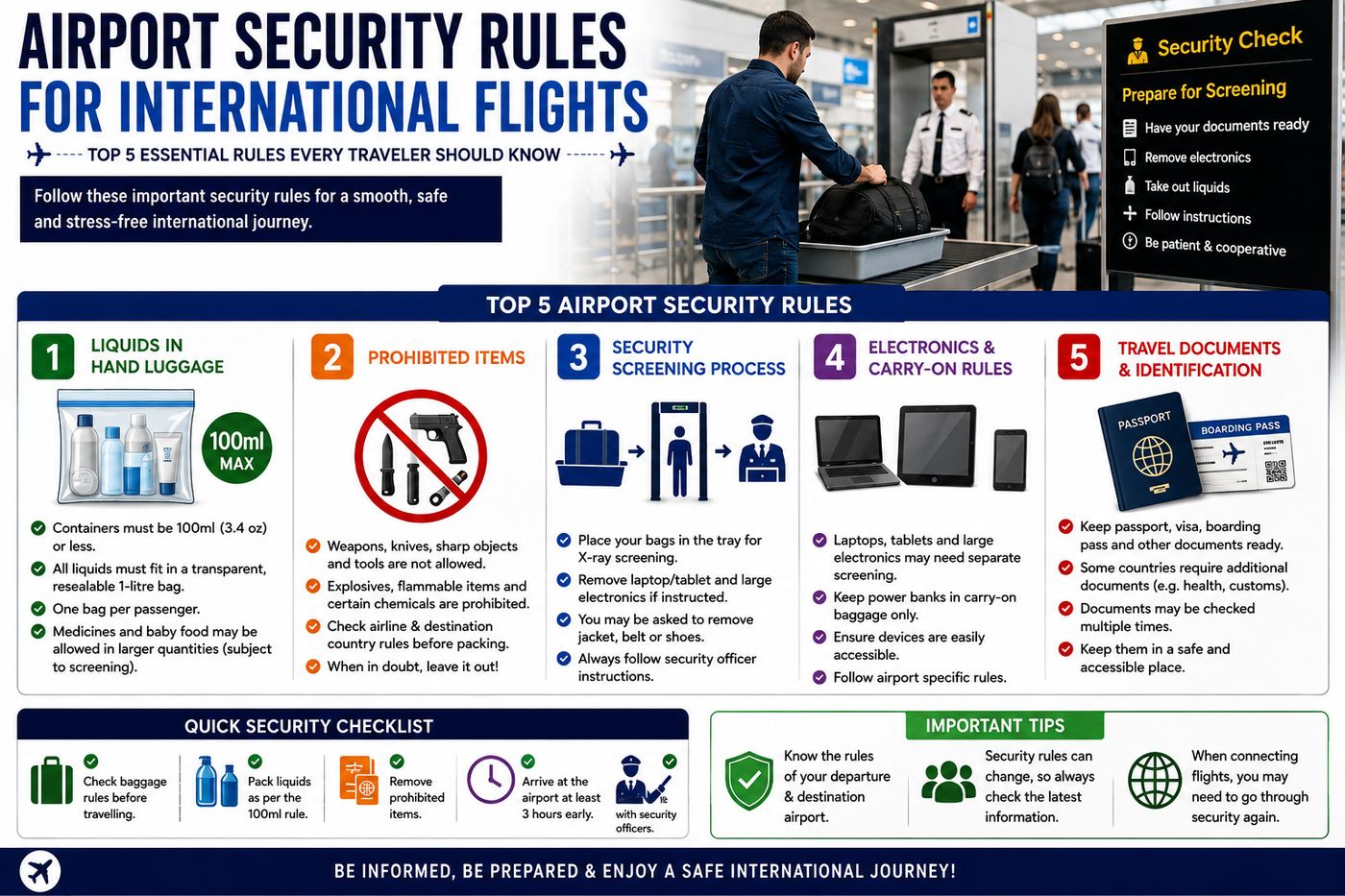
Traveling internationally can be exciting, but understanding airport security rules for international flights is essential before you pack your bags. Security procedures can vary by airport and country, but there are common rules covering liquids, carry-on baggage, prohibited items, electronics, identification, and passenger screening.
The most important rule is simple: always check the requirements of your departure airport, airline, and destination country before traveling, because security procedures can change. Official U.S. TSA and European Commission guidance, for example, provides detailed rules on liquids and prohibited items.
Read More:How Early to Arrive at Airport
1. Understand the Liquids Rule for Carry-On Baggage
One of the most important airport security rules for international flights involves liquids, gels, aerosols, creams, and similar items in your hand luggage.
A widely used rule at many airports is that liquids in carry-on baggage must be in individual containers of 100 ml (3.4 oz) or less. In the EU, these containers generally must fit inside one transparent, resealable bag with a maximum capacity of one litre. The U.S. TSA similarly applies its 3-1-1 rule for standard carry-on screening. (Mobility and Transport)
Examples of items treated as liquids or similar substances include:
- Water and other drinks
- Shampoo
- Perfume
- Lotion
- Toothpaste
- Hair gel
- Shaving foam
- Creams
- Aerosol sprays
Important Exceptions
Essential medicines, baby food, and certain dietary items may be allowed in larger quantities, but they can require separate screening or verification. (Transportation Security Administration)
If you are unsure about a specific item, check your airport or airline before departure.
2. Know Which Items Are Prohibited
Before packing, review the rules for both carry-on baggage and checked baggage.
Certain items may not be allowed in cabin baggage because they could pose a security risk. Depending on the rules at your departure airport, restricted items can include weapons, explosives, certain sharp objects, dangerous tools, and other hazardous materials.
European Commission guidance specifically identifies examples such as knives and razor blades, drills or saws, baseball bats, certain gases and sprays, and items that could be used to cause serious injury as restricted in hand luggage. Explosives, fireworks, and certain other dangerous articles may be prohibited from aircraft altogether. (Mobility and Transport)
Before Packing, Ask:
- Can this item go in my carry-on?
- Is it allowed only in checked baggage?
- Is it completely prohibited?
- Does my airline have additional restrictions?
The TSA’s official What Can I Bring? resource also notes that an item that is generally permitted may still receive additional screening or be refused if it creates a security concern. (Transportation Security Administration)
3. Prepare for Airport Security Screening
Airport security screening usually involves both passenger screening and baggage screening.
Depending on the airport and screening system, you may need to:
- Present your travel documents
- Place hand luggage on the screening belt
- Remove certain items from your pockets
- Follow instructions regarding electronics
- Place liquids separately when required
- Remove outer clothing such as a jacket or coat
- Walk through a screening device
- Undergo additional screening if requested
European Commission guidance explains that passengers and baggage are subject to security controls before boarding and may be required to remove items such as coats and metal objects for separate screening. (Mobility and Transport)
The exact process can differ between airports, so always follow the instructions provided by security staff.
4. Follow Carry-On Baggage and Electronics Rules
Your carry-on baggage rules are not limited to the size of your suitcase. Security rules also apply to what is inside it.
Large electronic devices may need to be screened separately at some security checkpoints. The exact requirement depends on the airport and the screening technology in use.
The TSA advises travelers to pack appropriately for screening and notes that large electronics may need to be accessible. It also warns that security officers can request that electronic devices be powered on during screening. (Transportation Security Administration)
Smart Packing Tips
To make security screening easier:
- Keep liquids easy to access.
- Place electronics where they can be removed quickly if requested.
- Avoid packing prohibited items.
- Start with an empty bag and check all pockets.
- Keep important documents easily accessible.
A well-organized bag can help reduce delays at the checkpoint.
5. Keep Your Travel Documents Ready
International flights often involve more document checks than domestic travel.
Depending on your destination, you may need:
- Passport
- Boarding pass
- Visa
- Residence permit
- Entry authorization
- Health or other travel documents where applicable
Your airline may verify some documents before issuing or confirming your boarding pass.
Keep your documents in a secure but easily accessible location. Do not wait until you reach the front of the line to search through your luggage.
For U.S. security screening, TSA requires acceptable identification for adult travelers and notes that passengers whose identity cannot be verified may not be allowed to proceed through the checkpoint. (Transportation Security Administration)
International Airport Security Checklist
Before leaving home, use this simple airport security checklist:
Documents
- Passport checked
- Boarding pass ready
- Visa requirements confirmed
- Destination entry requirements reviewed
Carry-On Bag
- Liquids checked
- Prohibited items removed
- Electronics accessible
- Medicines prepared for screening if necessary
- Valuable documents kept with you
Before Leaving
- Check your flight status
- Confirm the correct terminal
- Check airline baggage rules
- Review airport security guidance
- Allow enough time for check-in and security
How Early Should You Arrive for International Airport Security?
A common general guideline is to arrive around three hours before an international flight, but the correct arrival time depends on your airline, airport, destination, baggage requirements, and expected security or immigration procedures.
You may need additional time for:
- Check-in
- Baggage drop
- Document verification
- Security screening
- Passport control
- Immigration
- Walking to a distant departure gate
Always follow your airline’s official recommendation rather than relying only on a general rule.
Common Airport Security Mistakes to Avoid
Bringing Large Liquid Containers
A container larger than the applicable limit may be refused at the security checkpoint, even if it contains only a small amount of liquid. Check the container size and your departure airport’s rules.
Forgetting About Items in Your Bag
Old bags can contain forgotten items such as tools, sharp objects, or liquids.
Check every compartment before packing.
Assuming Every Airport Has Identical Rules
Security technology and procedures can vary. Some airports may require different preparation for electronics or liquids.
Ignoring Airline Rules
Airport security rules and airline baggage rules are not always the same thing. An item may pass security but still violate an airline’s baggage policy.
Opening Duty-Free Liquids Before a Connection
Duty-free liquids can be subject to special rules during connecting journeys. European guidance, for example, specifies conditions involving sealed security bags and receipts. (Mobility and Transport)
Airport Security Rules for Connecting Flights
If you have an international connecting flight, you may need to pass through another security checkpoint.
This is especially important when carrying duty-free liquids. European guidance explains that certain liquids purchased during travel may need to remain in an approved sealed security bag with proof of purchase to meet transfer requirements. (Mobility and Transport)
Before your journey, check:
- Whether you must pass through security again.
- Whether your carry-on liquids meet the transfer airport’s rules.
- Whether your duty-free purchases can remain in your hand luggage.
- Whether you need to clear immigration or collect baggage.
Frequently Asked Questions
How much liquid can I take on an international flight?
Rules vary by departure airport, but many major airports use a limit of 100 ml per individual container for standard carry-on liquids, with specific packaging requirements. Always confirm the current rule at your departure airport. (Mobility and Transport)
Can I take medication through airport security?
Medications are generally subject to security screening. Some medically necessary liquids may be permitted in quantities exceeding standard liquid limits, subject to the applicable rules and screening process. (Transportation Security Administration)
What items are not allowed in carry-on baggage?
Examples can include explosives, weapons, certain sharp objects, dangerous tools, and other restricted items. The exact rules depend on the airport and country. Check official guidance before packing. (Mobility and Transport)
Do I need to remove my laptop at airport security?
This depends on the airport and screening equipment. Some checkpoints require large electronics to be screened separately, while others do not. Follow the instructions at your specific checkpoint. (Transportation Security Administration)
Can international airport security rules change?
Yes. Security procedures and restrictions can change, so check the official airport, airline, and relevant aviation-security authority before traveling.
Final Thoughts
Understanding airport security rules for international flights can help you avoid delays, confiscated items, and unnecessary stress.
The Top 5 things to remember are:
- Follow liquid restrictions for carry-on baggage.
- Check prohibited and restricted items before packing.
- Prepare for passenger and baggage screening.
- Keep electronics and important items accessible.
- Have your passport and travel documents ready.
Naeem Abbas is a travel writer and frequent flyer with over 6 years of experience navigating airports across Asia, Europe, and the Middle East. He has flown with 40+ airlines and specializes in baggage policies, airport hacks, and honest airline reviews. Every guide on AirlineFeed is researched from official airline sources and real travel experience.
Naeem Abbas is a travel writer and frequent flyer with over 6 years of experience navigating airports across Asia, Europe, and the Middle East. He has flown with 40+ airlines and specializes in baggage policies, airport hacks, and honest airline reviews. Every guide on AirlineFeed is researched from official airline sources and real travel experience.