Qantas Baggage Allowance 2026: Complete Checked & Carry-On Guide
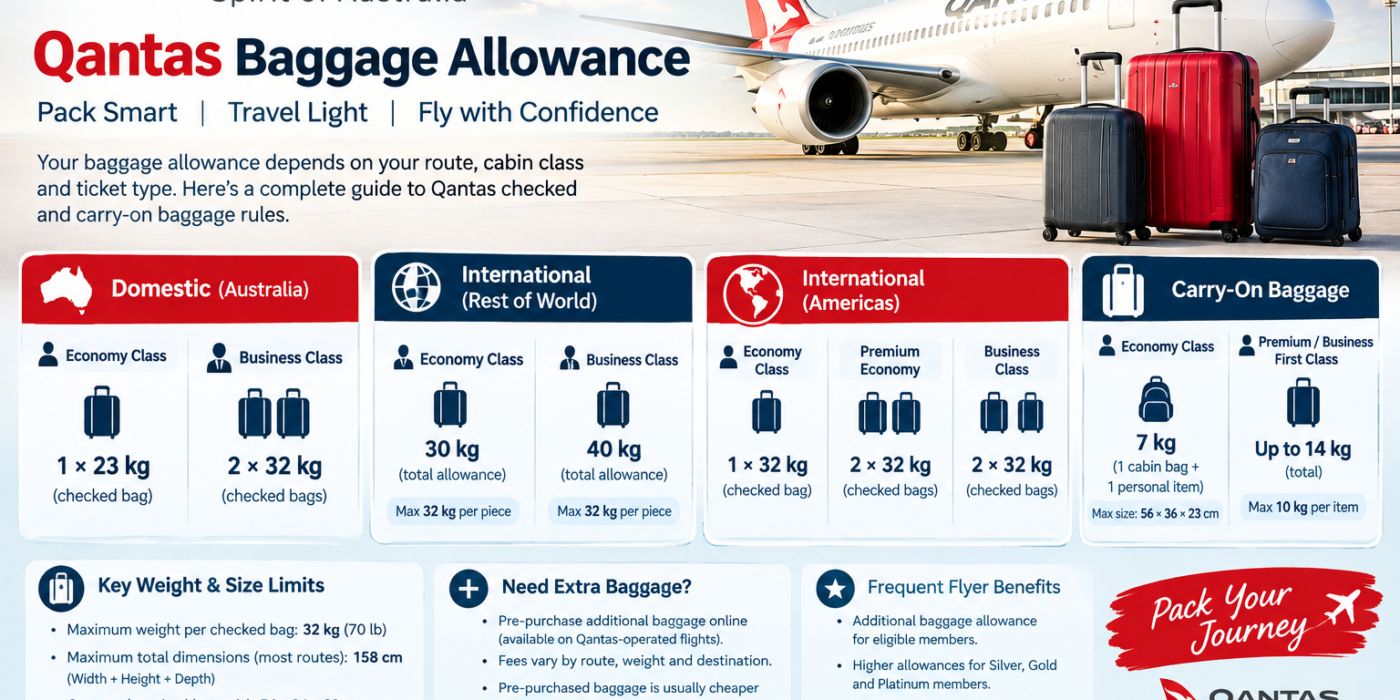
Planning to fly with Qantas and wondering how much luggage you can take? Understanding the Qantas baggage allowance before your trip can help you pack correctly, avoid unexpected charges and make airport check-in much easier.
Qantas baggage rules vary depending on your route, cabin class, ticket conditions and Frequent Flyer status. The airline includes checked baggage on Qantas flights, but the exact allowance can be based either on the number of pieces or a total weight allowance.
This complete guide covers the latest Qantas baggage allowance 2026, including domestic and international checked baggage, carry-on limits, Economy, Premium Economy and Business Class allowances, baggage weight limits, extra baggage and useful packing tips.
Read More: Flydubai Extra Baggage Charges
Qantas Baggage Allowance at a Glance
The following table provides a simple overview of common Qantas baggage allowances:
| Travel Type | Typical Allowance |
|---|---|
| Australian Domestic Economy | 1 × 23 kg |
| Australian Domestic Business | 2 × 32 kg |
| International Economy – rest of world | 30 kg |
| International Business – rest of world | 40 kg |
| International Economy – Americas | 1 × 32 kg |
| International Premium Economy – Americas | 2 × 32 kg |
| International Business – Americas | 2 × 32 kg |
| International Economy Carry-On | 7 kg |
| International Business Carry-On | Up to 14 kg total |
| Maximum single checked bag | 32 kg |
These are general Qantas-operated flight allowances. Your exact allowance can differ according to itinerary, fare and Frequent Flyer status, so checking the allowance shown in your booking is important.
What Is the Qantas Baggage Allowance?
The Qantas baggage allowance is the amount of checked and cabin baggage included with your Qantas ticket.
Unlike some airlines where passengers may need to purchase all checked baggage separately, Qantas states that checked baggage is included when you fly with Qantas. The amount depends on your route, cabin and Frequent Flyer status.
Your baggage allowance may be calculated in two ways:
- Piece concept: a specific number of bags with a maximum weight per bag.
- Weight concept: a total weight allowance, where there may be no restriction on the number of pieces as long as the total weight remains within the allowance.
For international Qantas flights excluding North and South America, several fares use a total weight allowance.
Qantas Domestic Baggage Allowance
For Australian domestic Qantas flights, Economy passengers generally receive:
1 checked bag up to 23 kg.
Business Class passengers generally receive:
2 checked bags up to 32 kg each.
There are exceptions for some QantasLink and island services, so passengers should check their individual booking.
For example, a standard domestic Economy passenger could have:
1 bag × 23 kg = 23 kg checked baggage allowance
A Business passenger could have:
2 bags × 32 kg = 64 kg total
subject to the applicable route and ticket conditions.
Qantas Economy Baggage Allowance
The Qantas Economy baggage allowance depends on whether you are travelling domestically, to the Americas or to other international destinations.
Australian Domestic Economy
For standard Qantas-operated domestic flights, Economy includes:
- 1 checked bag
- Maximum 23 kg
Some routes and aircraft have different rules.
International Economy to the Americas
For international flights to and from North or South America, the standard Economy allowance is:
- 1 checked piece
- Maximum 32 kg per piece
Qantas Frequent Flyer and Qantas Club benefits can provide additional baggage on eligible itineraries.
International Economy – Rest of the World
For many international destinations outside North and South America, Qantas uses a weight-based allowance.
Standard Economy passengers generally receive:
Up to 30 kg total.
There is still a maximum of 32 kg for any individual piece.
This means that if your allowance is 30 kg, you could potentially divide the luggage across more than one bag, provided you stay within the applicable rules and no individual piece exceeds 32 kg.
Qantas Premium Economy Baggage Allowance
Premium Economy provides a larger checked baggage allowance than standard Economy on many Qantas international itineraries.
For international flights to and from North or South America, Premium Economy generally includes:
2 pieces × 32 kg each.
For international travel to other destinations, the standard weight allowance is generally:
Up to 40 kg total.
Frequent Flyer status can increase the allowance further on eligible flights.
Travelers should check their ticket because the exact baggage conditions can depend on the itinerary.
Qantas Business Class Baggage Allowance
The Qantas Business Class baggage allowance provides more baggage capacity than Economy on many routes.
For Australian domestic flights:
- 2 pieces
- Up to 32 kg each
For flights to and from North or South America:
- 2 pieces
- Up to 32 kg each
For international destinations outside the Americas:
- Up to 40 kg total
- No individual piece over 32 kg
Qantas Frequent Flyer status can provide additional baggage on eligible routes.
Qantas International Baggage Allowance
The Qantas international baggage allowance depends heavily on the destination.
Qantas generally separates international baggage rules into two major categories:
Flights to North and South America
The baggage allowance is based on the number of pieces.
Typical standard allowances include:
- Economy: 1 × 32 kg
- Premium Economy: 2 × 32 kg
- Business: 2 × 32 kg
- First: 3 × 32 kg
Frequent Flyer status can provide additional pieces on eligible flights.
International Flights to Other Destinations
For many international destinations outside the Americas, Qantas uses a weight-based system.
Typical allowances are:
- Economy: 30 kg
- Premium Economy: 40 kg
- Business: 40 kg
Higher allowances may apply to eligible Qantas Frequent Flyer members.
Qantas Carry-On Baggage Allowance
The Qantas carry-on baggage allowance is different for domestic and international flights.
For international flights:
Economy
Passengers generally receive:
- 1 overhead cabin bag
- 1 personal item
- Maximum 7 kg
The main cabin bag must generally have total dimensions no greater than 115 cm.
Premium Economy, Business and First
Passengers generally receive:
- 1 overhead bag
- 1 under-seat bag
- 1 personal item
- Up to 14 kg total
- Maximum 10 kg for a single item
This provides more cabin baggage capacity than international Economy.
Qantas Carry-On Bag Size
For current Qantas domestic jet flights, the main cabin bag can measure up to:
56 cm × 36 cm × 23 cm
Passengers can also bring a small item such as a purse or laptop bag. Current domestic Economy allowance is 7 kg across the two items, while Business allows 14 kg total with a maximum of 10 kg for one item.
Qantas has also published updated carry-on arrangements for flights from 2 February 2027, so travelers with future bookings should check the applicable rules for their departure date.
Qantas Domestic Dash 8 Baggage Allowance
Dash 8 flights have different baggage restrictions because of the smaller aircraft.
For QantasLink Dash 8 services, the carry-on allowance is:
- 1 overhead bag
- 1 personal item
- Maximum 7 kg total
Small wheelie bags may not fit in the overhead compartment and can be collected at boarding and returned after arrival.
Checked baggage can also have special restrictions on Dash 8 services. Qantas states that only one checked piece up to 23 kg can be taken on these services, subject to specific exceptions.
Qantas Baggage Weight Limit
One of the most important Qantas baggage weight limits is the maximum weight of an individual checked bag.
No single checked baggage item can exceed:
32 kg (70 lb)
This rule applies even if your total baggage allowance is higher.
For example, if your Business Class allowance is 40 kg total, you cannot put all 40 kg into one suitcase.
Instead, you could use:
- Bag 1: 25 kg
- Bag 2: 15 kg
Total:
40 kg
Both individual bags remain below the 32 kg maximum.
Qantas Baggage Size Limit
Checked baggage must also meet Qantas’ size requirements.
For many piece-based international allowances, the maximum total dimension per piece is:
158 cm
This is calculated by adding:
Width + Height + Depth
For example:
70 cm + 50 cm + 30 cm = 150 cm
This would remain below the 158 cm standard limit.
Oversized baggage may be subject to additional conditions or charges.
Qantas Extra Baggage
If you need more luggage than your included allowance, Qantas provides options to pre-purchase additional baggage on eligible Qantas-operated flights.
Qantas recommends purchasing additional baggage before travelling because pre-purchased baggage can help avoid higher airport excess baggage charges.
Passengers can generally use Manage Booking to view and purchase additional baggage when the option is available.
However, pre-purchased additional baggage is not available in advance for some flights operated by another carrier, including certain codeshare or interline journeys.
Qantas Baggage Fees
Qantas baggage fees vary according to:
- Route
- Number of additional bags
- Domestic or international travel
- Weight
- Frequent Flyer status
- Whether baggage is purchased in advance or at the airport
There is no single worldwide Qantas baggage fee because the airline applies different pricing depending on the itinerary.
For example, Qantas’ published Canadian pricing shows different rates for pre-purchased additional baggage and airport excess baggage, illustrating how charges vary by route.
For the most accurate price, passengers should check the baggage option attached to their booking.
How to Add Extra Baggage on Qantas
If your included baggage is not enough, you can check whether additional baggage is available through Manage Booking.
A typical process is:
- Visit the Qantas website.
- Open Manage Booking.
- Enter your booking details.
- Select the relevant flight.
- Look for additional baggage.
- Select the required baggage allowance.
- Review the price.
- Complete payment.
Qantas states that additional baggage can be purchased online for eligible Qantas-operated flights with a QF code.
Qantas Baggage for Frequent Flyers
Qantas Frequent Flyer members can receive additional baggage benefits depending on their status.
For example, on international flights outside North and South America, the published total allowance can increase from:
- Economy: 30 kg for Bronze
- Economy: 42 kg for Silver/Qantas Club
- Economy: 46 kg for Gold
- Economy: 50 kg for Platinum/Platinum One
Premium Economy and Business also receive higher total allowances for eligible Frequent Flyer tiers.
On flights to and from the Americas, the benefits are generally expressed as additional pieces rather than total kilograms.
Qantas Baggage for Children
Children generally receive the same baggage allowance as adults when travelling internationally.
Qantas also provides additional allowances for certain child equipment. For example, children up to 12 years can generally take one car seat and one collapsible pram, stroller or push chair in addition to their checked baggage allowance.
Parents should still check the rules for their exact itinerary before travelling.
Qantas Power Bank and Battery Rules
Power banks should not be packed in checked baggage.
Qantas states that power banks and spare lithium batteries must be carried in cabin baggage and protected appropriately.
Before travelling, keep items such as:
- Power banks
- Spare lithium batteries
- Important electronics
in your carry-on bag rather than your checked suitcase.
Qantas Baggage on Partner Airlines
If your journey includes another airline, do not automatically assume that Qantas baggage rules apply.
Qantas specifically states that partner airline allowances may be different. Travelers can check the allowance shown in Manage Booking.
This is particularly important for connecting journeys involving:
- Qantas
- Jetstar
- oneworld airlines
- Other partner carriers
If different flights have different allowances, Qantas recommends packing according to the lowest applicable carry-on allowance for certain connecting itineraries.
How to Avoid Qantas Excess Baggage Charges
You can reduce the chance of unexpected baggage charges with a few simple steps.
Check Your Ticket
Your booking contains the most relevant allowance for your journey.
Weigh Your Suitcase
Use a luggage scale before leaving home.
Keep One Bag Below 32 kg
Even if your total allowance is higher, an individual checked bag cannot exceed 32 kg.
Measure Your Bags
Check the total dimensions before travelling.
Check Connecting Airlines
A partner airline may have different baggage conditions. For example, see the Jetstar baggage allowance for Jetstar-operated connections.
Buy Extra Baggage in Advance
If you already know you need additional luggage, check Qantas’ pre-purchase options before reaching the airport.
Common Qantas Baggage Mistakes
Assuming Every Economy Ticket Has 23 kg
Domestic Economy generally has 23 kg, but international Economy can use different allowances depending on destination.
Putting 40 kg in One Suitcase
A total 40 kg allowance does not mean one suitcase can weigh 40 kg. No individual checked piece can exceed 32 kg.
Forgetting About Dash 8 Flights
Dash 8 aircraft have different carry-on and checked-baggage limits.
Ignoring Partner Airline Rules
A connecting partner airline may apply its own baggage allowance.
Packing Power Banks in Checked Bags
Power banks must be carried in your cabin baggage according to Qantas’ current dangerous-goods guidance.
Final Thoughts
Understanding the Qantas baggage allowance 2026 before your flight can help you pack more efficiently and avoid unexpected charges.
For standard Australian domestic Qantas flights, Economy passengers generally receive 1 × 23 kg, while Business passengers generally receive 2 × 32 kg. For international travel outside the Americas, Economy generally has a 30 kg allowance and Business generally has a 40 kg allowance, with no individual checked piece exceeding 32 kg.
For international flights to and from North or South America, Qantas uses a piece-based system, with standard Economy generally receiving 1 × 32 kg, Premium Economy and Business 2 × 32 kg, and First 3 × 32 kg.
Carry-on baggage also varies by route and cabin. International Economy generally allows 7 kg, while international Premium Economy, Business and First can have up to 14 kg across permitted items.
Because Qantas baggage rules can vary according to route, fare, aircraft and Frequent Flyer status, always confirm the allowance shown in your booking before packing.
Frequently Asked Questions
How much baggage does Qantas Economy allow?
Australian domestic Economy generally includes 1 checked bag up to 23 kg. International Economy is generally 30 kg outside the Americas or 1 × 32 kg to/from North and South America.
What is the Qantas carry-on baggage allowance?
International Economy generally allows 7 kg, while international Premium Economy, Business and First generally allow up to 14 kg total, with a maximum of 10 kg per individual item.
How much baggage can I take on Qantas Business Class?
For Australian domestic flights, Business generally allows 2 × 32 kg. For international flights outside the Americas, the standard allowance is generally 40 kg total, while flights to/from the Americas generally allow 2 × 32 kg.
What is the maximum weight for one Qantas checked bag?
No individual checked bag can exceed 32 kg (70 lb).
Does Qantas charge for checked baggage?
Checked baggage is included on Qantas flights, but passengers may pay for additional baggage beyond their included allowance.
Can I buy extra baggage before my Qantas flight?
Yes. Qantas allows eligible passengers to pre-purchase additional baggage online for Qantas-operated flights.
Is Qantas baggage allowance the same for every route?
No. It depends on the route, cabin class, ticket and Frequent Flyer status.
What is the Qantas domestic baggage allowance?
Standard Australian domestic Economy generally includes 1 × 23 kg, while Business generally includes 2 × 32 kg. Exceptions apply on some routes and aircraft.
Can I take a power bank in checked baggage?
No. Qantas says power banks and spare lithium batteries must be carried in cabin baggage.
Related: Virgin Australia baggage allowance, Air New Zealand baggage allowance

Naeem Abbas is a travel writer and frequent flyer with over 6 years of experience navigating airports across Asia, Europe, and the Middle East. He has flown with 40+ airlines and specializes in baggage policies, airport hacks, and honest airline reviews. Every guide on AirlineFeed is researched from official airline sources and real travel experience.
Naeem Abbas is a travel writer and frequent flyer with over 6 years of experience navigating airports across Asia, Europe, and the Middle East. He has flown with 40+ airlines and specializes in baggage policies, airport hacks, and honest airline reviews. Every guide on AirlineFeed is researched from official airline sources and real travel experience.