SWISS Baggage Allowance 2026: Complete Checked and Carry-On Baggage Guide
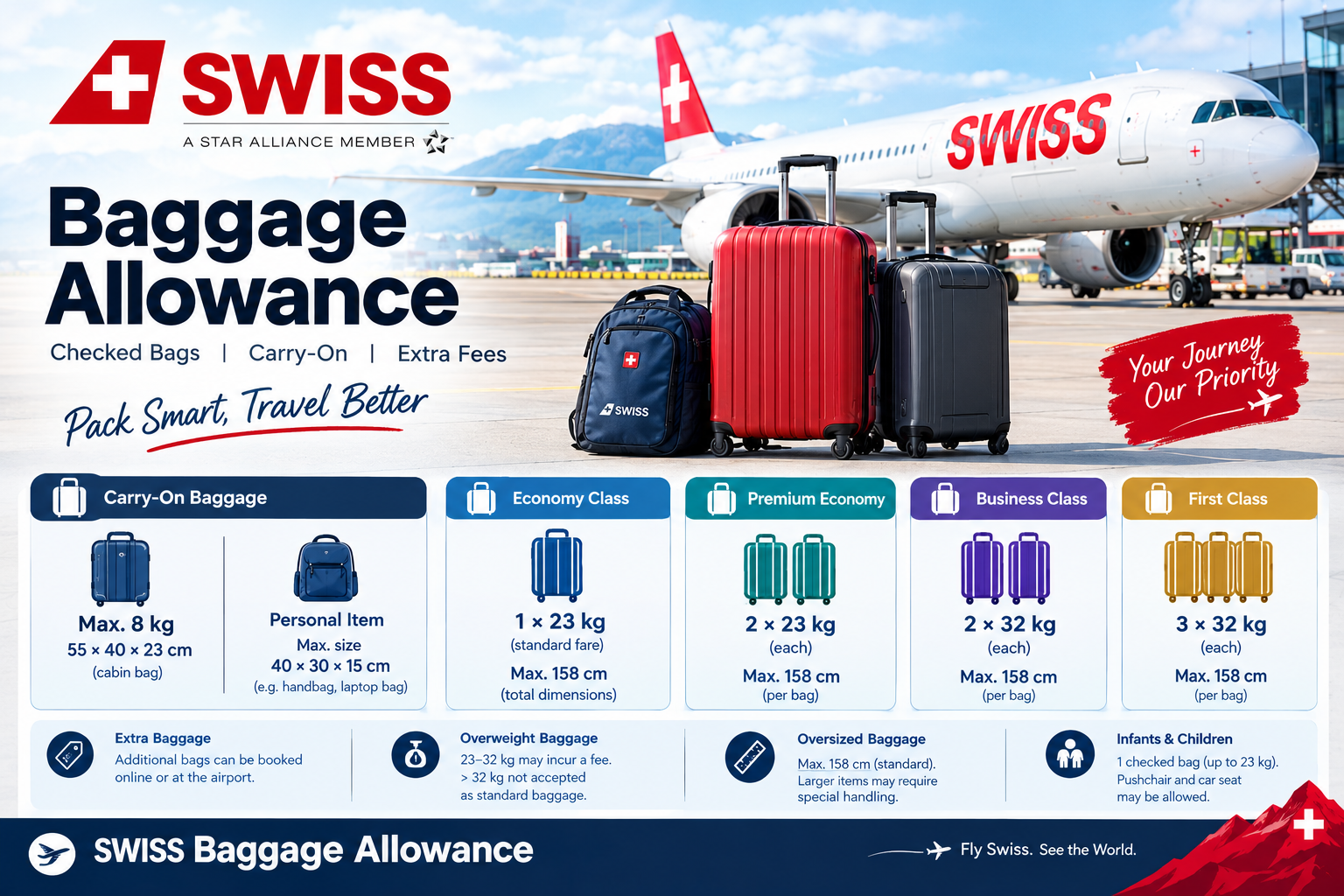
Planning a trip with SWISS International Air Lines? Before packing your suitcase, it is important to understand the SWISS baggage allowance, including checked luggage limits, cabin bag dimensions, weight restrictions, and extra baggage charges. Knowing your allowance in advance can help you avoid unexpected airport fees and make your journey more comfortable.
SWISS baggage rules depend on several factors, including your travel class, ticket type, route, and whether another airline operates part of your journey. Economy Light passengers, for example, may have different checked baggage benefits from travelers holding Classic or Flex tickets.
In this complete guide, AirlineFeed.com explains SWISS checked baggage allowance, carry-on baggage rules, Economy and Business Class limits, oversized luggage restrictions, and ways to prepare your bags before departure.
Read More: Cebu Pacific Baggage Allowance 2026
SWISS Baggage Allowance at a Glance
SWISS generally uses a piece-based baggage system on many international routes. This means your allowance specifies how many bags you can check and the maximum weight permitted for each bag.
| Travel class or fare | Typical checked baggage allowance on intercontinental routes |
|---|---|
| Economy Light | No checked bag included |
| Economy standard fares | 1 bag up to 23 kg |
| Premium Economy | 2 bags up to 23 kg each |
| Premium Economy Light | 1 bag up to 23 kg |
| Business Class | 2 bags up to 32 kg each |
| Business Light | 1 bag up to 32 kg |
| First Class | 3 bags up to 32 kg each |
These are general allowances, not a guarantee for every ticket. European routes have different fare combinations, and some destinations have special baggage rules. Always confirm your allowance on your ticket and the official SWISS checked baggage page.
1. SWISS Checked Baggage Allowance
Checked baggage is the luggage you hand over at the airport check-in counter. It travels in the aircraft’s hold and is collected at your destination.
Your SWISS checked baggage allowance depends on the fare purchased and the route. On many intercontinental flights, standard Economy includes one checked bag weighing up to 23 kg. Premium cabins generally provide a higher allowance.
Economy Class checked baggage
On intercontinental flights, standard SWISS Economy fares usually include one checked bag weighing up to 23 kg. Economy Light does not normally include checked baggage, so passengers who need a suitcase must purchase the relevant baggage option or select a fare that includes it.
On European routes, fare names and benefits can differ. Some entry-level fares exclude checked luggage, while eligible Classic, Flex, or Comfort fares may include one bag up to 23 kg.
Before booking, compare the total ticket price with the cost of adding baggage. A slightly higher fare that includes a suitcase may offer better value than buying a basic ticket and paying for luggage separately.
Premium Economy baggage allowance
SWISS Premium Economy passengers on many intercontinental routes can check two bags weighing up to 23 kg each. The Premium Economy Light fare generally includes one checked bag instead of two.
This extra capacity can be useful for longer holidays, family visits, or journeys that require additional clothing and personal belongings.
Business Class baggage allowance
SWISS Business Class generally allows two checked bags, each weighing up to 32 kg, on intercontinental routes. Business Light usually includes one checked bag weighing up to 32 kg.
European Business fares may have different benefits depending on the specific fare purchased. Review your ticket rather than assuming that every Business Class booking includes the same number of bags.
First Class baggage allowance
On eligible intercontinental routes, SWISS First Class generally includes three checked bags, each weighing up to 32 kg. This generous allowance can suit travelers carrying several suitcases for an extended trip.
First Class availability and fare conditions vary by route and aircraft. Confirm the exact allowance for your booking before traveling.
2. SWISS Carry-On Baggage Allowance
Carry-on baggage, also called cabin baggage or hand luggage, is the bag you take into the aircraft cabin. It is normally stored in the overhead compartment.
SWISS publishes the following standard cabin baggage dimensions:
- Maximum dimensions: 55 × 40 × 23 cm
- Maximum weight: 8 kg per permitted cabin bag
- Personal item dimensions: 40 × 30 × 15 cm
The personal item may be a small handbag, laptop bag, or similar item that fits under the seat in front of you. The exact number of permitted cabin bags depends on your fare and travel class.
Economy and Premium Economy carry-on rules
On many long-haul flights, Economy and Premium Economy passengers may bring one cabin bag weighing up to 8 kg, plus one personal item.
However, the short- and medium-haul Economy Basic fare may include only one personal item rather than a full-size cabin trolley. Other eligible fares, such as Economy Light and higher fare types, can include a cabin bag.
This distinction is important: a personal item is not the same as a standard cabin suitcase. Check the fare rules for your specific route before arriving at the airport.
Business and First Class carry-on rules
On many flights, Business and First Class passengers may take two cabin bags, each weighing up to 8 kg, along with one personal item.
Aircraft capacity, security requirements, and local regulations can create exceptions. For example, passengers departing from the United States may face restrictions on taking additional cabin bags through security.
For the latest details, consult the official SWISS carry-on baggage rules.
3. SWISS Baggage Allowance by Fare Type
Choosing the correct fare is one of the easiest ways to manage your luggage costs.
Economy Basic
Economy Basic is an entry-level fare available on certain short- and medium-haul routes. It can be particularly restrictive for travelers who expect to bring a rolling cabin suitcase.
On applicable European routes, Economy Basic includes one personal item but does not automatically include a full-size cabin bag or checked suitcase. Additional baggage may be purchased subject to the fare rules.
Economy Light
Economy Light is designed for passengers who want a lower fare and can travel with limited luggage. On intercontinental routes, it generally does not include a checked bag, although a cabin bag may be included.
If you need to check a suitcase, compare the cost of adding it with the price of an Economy fare that already includes checked baggage.
Classic, Comfort, and Flex fares
Eligible standard Economy fares often include a checked bag on routes where that benefit applies. Depending on the journey, the fare may also provide additional flexibility or other travel benefits.
Do not assume that the fare names and allowances are identical on European and intercontinental services. Check the conditions shown during booking.
Light fares in premium cabins
Premium Economy Light and Business Light can provide fewer checked bags than their standard counterparts. This is why travelers should check both their cabin class and their precise fare type before packing.
4. SWISS Checked Baggage Size and Weight Limits
Knowing the maximum baggage weight is not enough. Your suitcase must also meet the permitted dimensions.
Standard checked baggage dimensions
SWISS generally limits a standard checked bag to 158 cm in total dimensions, calculated by adding its width, height, and depth.
For example, a suitcase measuring 70 cm high, 50 cm wide, and 30 cm deep has total dimensions of 150 cm. It falls within the standard 158 cm limit, provided its weight also meets the applicable allowance.
Measure your suitcase from its outermost points, including wheels and handles where relevant.
Maximum baggage weight
The standard allowance is commonly 23 kg per bag in Economy and Premium Economy, while eligible Business and First Class allowances can permit up to 32 kg per bag.
SWISS generally does not accept an individual checked bag weighing more than 32 kg as regular passenger baggage. Bags exceeding the permitted size may be treated as excess or special baggage, subject to the airline’s rules.
Do not combine the weight limits of separate bags unless the applicable policy explicitly allows it. A total allowance of 46 kg, for example, does not necessarily mean you can check one bag weighing 46 kg.
5. SWISS Extra Baggage Fees
If your luggage exceeds the free allowance, additional charges may apply. The amount depends on factors such as your route, ticket type, baggage quantity, and whether the bag is overweight or oversized.
SWISS does not have one universal extra baggage price for every journey. Use the airline’s baggage calculator or Manage Booking service to check the price for your specific flight.
How to book additional baggage
Passengers can generally purchase eligible additional baggage through the SWISS website or Service Centre. The airline says that eligible customers can book up to two additional bags, each weighing up to 23 kg, at the applicable special rate. Online booking for an existing reservation is generally available up to two hours before departure.
Availability and restrictions may differ by route, so arrange additional baggage as early as possible.
How to avoid extra baggage charges
Follow these practical steps:
- Check your ticket to confirm the included number of bags.
- Weigh each suitcase at home.
- Measure the suitcase before leaving for the airport.
- Compare the price of adding baggage online with a fare that already includes a checked bag.
- Purchase extra baggage in advance when available.
- Check your allowance again if your itinerary includes another airline.
These steps can help prevent unexpected costs at check-in or the boarding gate.
6. SWISS Baggage Allowance for Flights to Pakistan
Travelers flying between Pakistan and destinations in Europe, North America, or other regions should pay particular attention to route-specific rules.
SWISS lists special Economy baggage allowances for certain routes. For example, eligible journeys between the United States, Canada, or Mexico and Pakistan may have an allowance of two bags up to 23 kg each. This is a route-specific exception, not a universal allowance for every ticket to or from Pakistan.
Your fare, origin, destination, connecting itinerary, and operating airline may affect the final allowance. Check the baggage information printed on your e-ticket and use the official baggage calculator before packing.
7. SWISS Baggage Rules for Infants and Children
Traveling with a baby requires additional planning. SWISS generally permits a foldable pushchair or travel pram for small children, subject to its applicable conditions.
Eligible infants may also receive a checked baggage allowance of up to 23 kg, but this benefit is not included in every fare. Light fares can have different restrictions.
Children traveling in their own seat have baggage entitlements according to their ticket and travel class. If you are bringing a stroller, child seat, or other child-related equipment, confirm how it will be handled before departure.
8. Traveling With Connecting Flights
If your itinerary includes multiple airlines, baggage rules may not be the same on every segment. A flight sold under a SWISS flight number could be operated by a partner airline, and the operating carrier’s rules may apply to cabin baggage.
On connecting journeys, the applicable checked baggage rules can depend on the itinerary and the airline marketing the most significant part of the trip. Separate tickets or a long stopover can also affect how baggage is handled.
Read your booking confirmation carefully and check each operating airline’s policy. When rules differ, confirm the most restrictive cabin baggage requirement so you are not caught out at the airport.
9. Tips for Packing Within the SWISS Baggage Allowance
A few simple habits can make your trip easier:
- Use a luggage scale to avoid exceeding your weight limit.
- Choose a cabin bag that fits within 55 × 40 × 23 cm.
- Keep your personal item small enough to fit under the seat.
- Place heavier items near the center of your suitcase for easier handling.
- Keep travel documents, medication, valuables, and essential electronics in your cabin bag.
- Leave room for souvenirs if you plan to shop during your trip.
- Check rules for restricted items, liquids, and batteries before packing.
- Keep your baggage receipt until you have collected your luggage.
If you are traveling with family, distribute belongings across bags according to each passenger’s allowance rather than assuming that every ticket has identical benefits.
10. Frequently Asked Questions About SWISS Baggage Allowance
How many checked bags can I take on SWISS Economy?
On many intercontinental routes, standard Economy includes one checked bag up to 23 kg. Economy Light generally includes no checked bag. Some destinations and fares have exceptions, so verify your ticket.
What is the SWISS cabin baggage size limit?
The standard cabin bag size is 55 × 40 × 23 cm, with a maximum weight of 8 kg per permitted bag. A personal item can measure up to 40 × 30 × 15 cm. Fare-specific restrictions may apply.
Does SWISS Economy Light include checked baggage?
Generally, no. Economy Light usually excludes checked baggage on intercontinental flights. You may be able to purchase a bag separately or choose another fare.
How much baggage is allowed in SWISS Business Class?
On many intercontinental flights, Business Class includes two checked bags of up to 32 kg each. Business Light generally includes one checked bag up to 32 kg. European fare conditions may differ.
What happens if my suitcase is overweight?
An overweight suitcase may incur an additional fee, depending on your route and allowance. Standard checked bags generally cannot weigh more than 32 kg. Contact SWISS before traveling if your luggage exceeds the permitted limits.
Can I buy extra baggage after booking?
Yes. SWISS generally allows eligible passengers to purchase additional baggage through its website or Service Centre. The airline states that online additional baggage can generally be booked up to two hours before departure, subject to availability and route conditions.
Is the baggage allowance the same on every SWISS flight?
No. Your allowance may change according to fare type, route, cabin class, frequent-flyer status, and partner-airline rules. Your ticket and the official baggage calculator are the best places to confirm your personal allowance.
Conclusion
Understanding the SWISS baggage allowance before departure helps you choose the right fare, pack within the permitted limits, and reduce the risk of unexpected baggage charges. Standard intercontinental Economy commonly includes one checked bag up to 23 kg, while Premium Economy, Business, and First Class offer different allowances. Economy Light and other restricted fares may exclude some baggage benefits.
Always check your checked luggage weight, suitcase dimensions, cabin baggage allowance, and route-specific conditions before traveling. For the most accurate information, visit the official SWISS baggage policy and review the allowance on your ticket.
For more airline baggage policies, airport guides, and travel tips, visit AirlineFeed.com — Fly Smarter. Travel Better.
Naeem Abbas is a travel writer and frequent flyer with over 6 years of experience navigating airports across Asia, Europe, and the Middle East. He has flown with 40+ airlines and specializes in baggage policies, airport hacks, and honest airline reviews. Every guide on AirlineFeed is researched from official airline sources and real travel experience.
Naeem Abbas is a travel writer and frequent flyer with over 6 years of experience navigating airports across Asia, Europe, and the Middle East. He has flown with 40+ airlines and specializes in baggage policies, airport hacks, and honest airline reviews. Every guide on AirlineFeed is researched from official airline sources and real travel experience.