What Can You Bring in a Carry-On? TSA Rules 2026
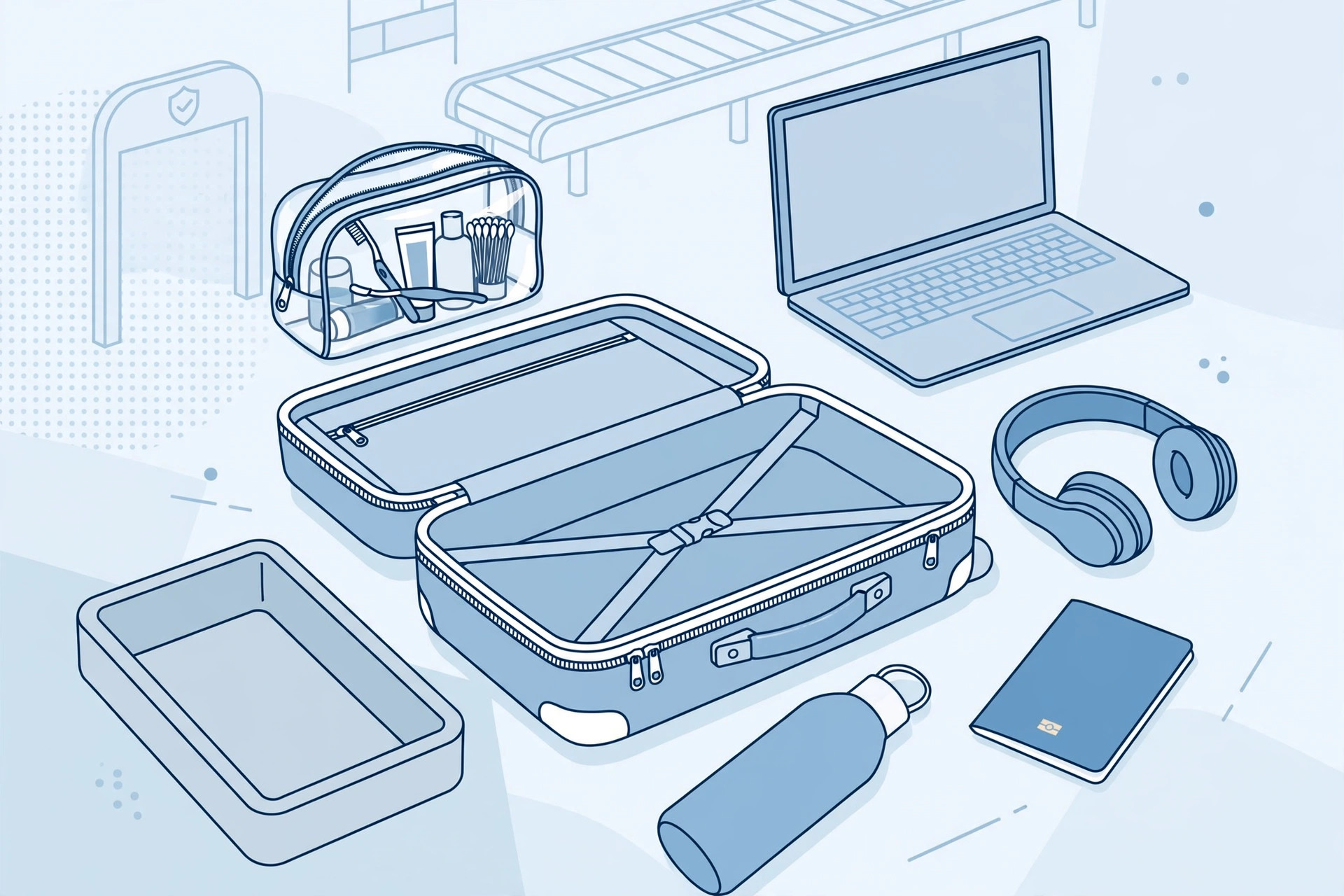
Packing for a flight always starts with the same question: what can you bring in a carry-on without getting stopped at the security checkpoint? The short answer is reassuring — most everyday items are allowed in the cabin, and far more than most travellers think. The long answer is what this guide is for. The US Transportation Security Administration (Wikipedia) applies one consistent set of rules at every American airport, built around a simple idea: anything that could be used as a weapon, an explosive, or a liquid-borne threat stays out of the cabin. Below, we break down exactly what that means in 2026 — the liquids rule, electronics and batteries, food, sharp objects, medications, sporting goods, and the items that will always get confiscated — plus a step-by-step packing method and quick answers to the questions travellers ask most.
The 3-1-1 Liquids Rule, Explained
The single most misunderstood carry-on rule is the 3-1-1 rule for liquids, and it still causes more checkpoint confiscations than anything else. Travellers asking what can you bring in a carry-on usually start here, because this rule decides the fate of half the toiletry bag. The rule is simple once you learn it: each passenger may carry liquids, gels and aerosols in containers of 3.4 ounces (100 millilitres) or less, all placed inside one quart-sized (roughly 1-litre), clear, resealable bag — one bag per passenger. Anything bigger goes in checked luggage or gets left behind.
What counts as a liquid, gel, or aerosol?
The TSA is generous in its definition, which is exactly what trips people up. Everything on this list must fit the 3-1-1 rule: shampoo, conditioner, shower gel, toothpaste, mouthwash, sunscreen, lotion, contact lens solution, deodorant (gel and spray — solid stick deodorant is exempt), perfume, cologne, hair spray, shaving foam, foundation, mascara, lip gloss, nail polish, liquid blush, peanut butter, honey, jam, yoghurt, hummus, dips, sauces, gravy, soup, olive oil, maple syrup, and snow globes (the liquid kind that look decorative and innocent). If you can pour it, squeeze it, spread it, spray it, or pump it, the rule applies.
Solids are generally fine without restriction: bar soap, solid shampoo bars, powder makeup, eyeshadow, blush powder, deodorant sticks, and lipstick all pass through without the bag limit. Many frequent flyers have quietly switched their toiletries to solid formats — a shampoo bar and a bar of soap sidestep the liquids rule entirely and never leak.
The 100 ml limit applies to the container, not the contents
This is the detail that catches careful packers: the limit applies to the container size, not how much is left inside. A nearly empty 200 ml shampoo bottle is still a 200 ml bottle, and it will be confiscated. Travel with containers that are 100 ml / 3.4 oz or smaller by design — decanting your full-size products into labelled travel bottles is the cheapest fix.
Medically necessary liquids and baby formula are exempt
Medication, breast milk, and baby formula are exempt from the 3-1-1 rule: you may bring them in quantities larger than 3.4 ounces, in reasonable amounts for your trip. Declare them to the officer at the checkpoint — they will be screened separately, often with a vapour or bottle test rather than opening the container. The same exemption covers medically necessary liquids such as liquid prescriptions, saline solution for contacts, and gel-filled medical supplies. Keep prescriptions in their original labelled containers and you will save yourself a conversation.
One more nuance: frozen liquids are allowed if completely frozen solid when presented at screening — a frozen bottle of water, for instance, passes, but if it has partially melted, the 3-1-1 rule kicks in. Ice packs for medication follow the same logic.
Electronics and Lithium Batteries
Electronics are broadly welcome in the cabin — and, crucially, the most power-hungry ones must travel there rather than in the hold.
Laptops, tablets, cameras, phones, and e-readers
All standard consumer electronics are allowed in carry-on bags: laptops, tablets, smartphones, e-readers, cameras, camcorders, portable gaming consoles, Bluetooth speakers, electric toothbrushes, and hair straighteners. At the checkpoint, be ready to place larger electronics in a separate bin — though many airports now use CT scanners that let you leave everything inside your bag, so follow the signs at your specific lane. If you are flying internationally, note that some destinations have their own electronics-screening procedures on arrival.
Power banks and spare lithium batteries: carry-on only
This is the rule travellers violate most often, because it feels backwards: spare lithium batteries and power banks are prohibited in checked luggage and must travel in the cabin. A damaged or short-circuited battery can smoulder, and a fire in the cargo hold is far more dangerous than one the cabin crew can reach. The limits: batteries up to 100 watt-hours (Wh) per battery are fine with no approval needed — virtually every phone charger, laptop battery and power bank falls in this range. Batteries between 101 and 160 Wh (larger professional camera and laptop batteries) need airline approval, limited to two per passenger. Anything above 160 Wh is a no-go on passenger flights entirely.
Practical tip: pack power banks where you can reach them, and switch them off (not just asleep) during the flight — some airlines now ask for this. If you are unsure of a battery’s Wh rating, check the label; it is usually printed on the battery itself.
Food and Drink: What You Can Bring
Bringing your own food on a plane is almost always allowed — and it is one of the easiest ways to eat well and spend less when travelling. If your version of “what can you bring in a carry-on” is mostly about snacks and meals, here is the full picture.
Solid food: always allowed
Sandwiches, wraps, salads, fruit, vegetables, crisps, nuts, biscuits, chocolate, cheese, cooked meats, baby food pouches (solid/semi-solid baby food is treated generously), and bakery items all pass through security without any issue. Many travellers do not realise that a full meal from an airport restaurant outside security is also fine to carry on — buy it landside and bring it through.
Liquids, soups, spreads, and sauces
Here the 3-1-1 rule returns: anything spreadable or pourable in quantities over 100 ml — soup, yoghurt, peanut butter, jam, hummus, guacamole, salad dressing, maple syrup, salsa — must fit inside your quart bag in a compliant container or travel in checked luggage. A whole jar of peanut butter will be confiscated; a single-serve 100 ml tub will not. Canned foods count too: a tin of soup is a liquid container, and if the can is bigger than 100 ml, it will not fly in the cabin.
Alcohol rules
Mini bottles of alcohol (the standard 50 ml airline minis) may travel in your carry-on inside your quart-sized liquids bag, like any other liquid. Drinks under 24% ABV face no quantity restriction beyond airline baggage limits; drinks between 24% and 70% ABV are limited to 5 litres per passenger (practically a checked-bag matter); anything over 70% ABV — most high-proof spirits — is prohibited entirely. And one rule is absolute everywhere: you may not drink your own alcohol on board. That is an airline and aviation-authority rule worldwide, and crew can and do report it.
Empty water bottles are always allowed through security — bring one and fill it at a drinking fountain after the checkpoint. It is the single cheapest travel habit there is.
Sharp Objects: Scissors, Razors, Knives, and Tools
Sharp objects are where the rules get specific, and knowing the exact cut-offs saves good tools from the confiscation bin.
- Scissors: allowed in the cabin if the blades are shorter than 4 inches (10 cm) measured from the pivot point. Standard craft and nail scissors pass; shears do not.
- Disposable and cartridge razors: allowed. The blade is enclosed, so there is no restriction.
- Safety razors: allowed only with the blade removed — the loose blade itself must go in checked luggage.
- Straight razors / cut-throat razors: not allowed in the cabin; pack them in checked bags.
- Knives: prohibited in the cabin, with one narrow exception — round-bladed butter knives and plastic cutlery are allowed. Pocket knives, box cutters, multi-tools with blades, and even small penknives must be checked.
- Tools: hand tools shorter than 7 inches (18 cm) — screwdrivers, wrenches, pliers — are allowed in carry-ons. Anything longer, plus drills, saws, and crowbars, must be checked.
- Nail clippers, tweezers, and nail files: allowed without restriction.
The pattern is worth internalising: enclosed or tiny blades are fine; exposed, lockable, or long blades are not. When in doubt, check it — replacing a confiscated multi-tool costs more than a few minutes at the bag drop.
Lighters, Matches, E-Cigarettes, and Vapes
Fire-related items are tightly controlled, but the rules are more permissive than most people expect:
- Disposable and Zippo lighters: allowed in the cabin (one per person is the practical norm). They may not go in checked luggage.
- Torch lighters / jet lighters: prohibited in both cabin and checked bags — the intense blue-flame lighters are banned outright.
- Safety matches: one book of safety matches may be carried on your person. Strike-anywhere matches are prohibited everywhere.
- E-cigarettes and vapes: must travel in carry-on baggage only — never checked, because of the battery fire risk. Using them on board is prohibited on every airline, and spare e-liquid follows the 3-1-1 liquids rule.
Medications and Medical Devices
The TSA treats medical necessities with unusual flexibility — the rules are designed so that nobody has to choose between their health and their flight. For travellers managing a condition, what can you bring in a carry-on includes every medication and device you need, with generous exemptions from the liquids rule.
Pills, liquid medication, and syringes
Prescription and over-the-counter pills, capsules, and vitamins are allowed in unlimited quantities — keep them in their original labelled containers to avoid questions. Liquid medications, gels, and creams over 3.4 ounces are allowed in reasonable quantities once declared at the checkpoint. Syringes and EpiPens are permitted when accompanied by the medication they are for; a prescription label on the medication closes the loop. Insulin pumps, glucose monitors, and related supplies travel with you, not in the hold.
CPAP machines, breast pumps, and mobility aids
CPAP machines are allowed in the cabin and do not count against your carry-on allowance on US airlines — they are medical devices, and airlines must accommodate them. Keep yours accessible, because it may need separate screening, and bring distilled water in a sealed container under 3.4 oz or buy it after security. Breast pumps are similarly allowed with their milk, coolers, and ice packs; inform the officer and they will be screened as medical items. Walking canes, crutches, and wheelchairs pass through screening with you — you will be screened by pat-down or alternative method while your device is X-rayed or hand-checked. Umbrellas, by the way, are also allowed in the cabin without restriction.
Sporting Goods and Outdoor Gear
Sporting equipment splits cleanly: anything that could double as a weapon goes in the hold.
- Allowed in the cabin: tennis rackets, badminton rackets, squash rackets, ice skates, fishing rods (within airline size limits), snorkelling gear, yoga mats, skateboards (most airlines allow them; check yours), and bicycle helmets.
- Must be checked: baseball and softball bats, golf clubs, hockey and lacrosse sticks, ski and snowboard equipment, tent poles, trekking poles with sharp tips, ice axes, crampons, martial arts weapons, and archery equipment.
- Fishing tackle: small hooks, flies, and lures are fine in the cabin; large sharp hooks and anything that could be considered dangerous should be sheathed and packed in checked bags.
Musical instruments deserve a special mention: small instruments (guitars, violins, trumpets) are allowed in the cabin when they fit in the overhead bin or under the seat — US law even requires airlines to let you stow a small instrument in the cabin if space is available at boarding. Larger instruments need a purchased seat or must travel as checked baggage.
Always Banned From the Cabin
Some items are prohibited from carry-on bags on every flight, no exceptions. Knowing what can you bring in a carry-on also means knowing what you cannot — if any of these are in your packing pile, move them to checked luggage or leave them home:
- Firearms — must travel unloaded in a locked hard-sided case in checked baggage, declared to the airline at check-in. Ammunition must be in its original packaging in checked bags.
- Knives of any real kind — pocket knives, hunting knives, box cutters, throwing stars.
- Explosives and flammables — fireworks, flares, gunpowder, lighter fluid, spray paint, bleach, and torch lighters.
- Self-defence items in the cabin — pepper spray, mace, stun guns, and tasers. (One 4 oz container of pepper spray with a safety mechanism is allowed in checked baggage; stun guns may travel in checked bags too.)
- Blunt instruments — baseball bats, clubs, batons, brass knuckles, nunchucks.
- Compressed gases — butane, propane, CO₂ cartridges beyond small life-vest allowances, scuba tanks.
- Corrosives and poisons — acids, chlorine, tear gas, bear spray (prohibited entirely, even checked).
- Alcohol over 70% ABV — prohibited in both cabin and checked baggage.
One item surprises travellers every year: Samsung Galaxy Note 7 phones remain specifically banned from all US flights by emergency order, carry-on and checked alike — a legacy of the 2016 battery fires that airlines still enforce.
TSA vs International Rules: Key Differences
TSA rules govern US airport checkpoints, but your destination’s rules govern the return leg — and they are not identical. The European Union and the UK follow broadly the same 100 ml liquids regime, but enforcement details differ: some EU airports have begun lifting the liquids limit where new CT scanners are installed, while others have reimposed it, so assume 100 ml until the signs at your airport say otherwise. Australia, Canada, and Japan all run equivalent liquid restrictions with minor variations in exemptions.
Two international quirks worth knowing: in the UK, the 100 ml rule is being phased out airport by airport as scanners arrive — but until your specific airport announces the change, the old limit stands. In several Middle Eastern and Asian hubs, power banks face stricter scrutiny than in the US, with some airlines banning their use entirely in flight. And duty-free liquids bought abroad are only guaranteed through a US connection when sealed in a tamper-evident bag with the receipt visible — keep that bag sealed until you clear your final US checkpoint.
For a broader sense of how carry-on allowances themselves differ between airlines, our airline carry-on size limits 2026 comparison covers the exact dimensions each major carrier allows.
Step-by-Step: Pack a Carry-On That Always Passes Security
What can you bring in a carry-on becomes much simpler once packing follows a system. Here is the routine frequent flyers use:
Step 1 — Start with the liquids bag. Put every liquid, gel, cream, and aerosol into 100 ml containers inside one quart-sized clear bag. Do this first; it is the item you will need at the checkpoint.
Step 2 — Separate the electronics. Keep your laptop, tablet, and large camera near the top of the bag so you can lift them out if the lane requires it. Stash power banks in an outside pocket, switched off.
Step 3 — Audit for sharps. Scan your toiletry kit and pockets: nail scissors under 4 inches stay, pocket knives and multi-tools go to checked luggage (or stay home). Safety razor blades travel in the hold.
Step 4 — Declare the exceptions. Medications over 3.4 oz, breast milk, formula, and medical devices get their own pouch — tell the officer about them before your bag enters the X-ray.
Step 5 — Pack food last, on top. Dense food items look like suspicious masses on X-ray screens. Keeping them accessible means a quicker bag check if yours is flagged.
Step 6 — Do the forbidden-item sweep. Before zipping up, run through the banned list: lighters (fine, one), torch lighter (remove), pepper spray (checked only), tools over 7 inches (checked), full-size toiletries (decant or check). Thirty seconds here saves a confiscation and a missed flight.
One final check that is about the bag itself, not its contents: if your carry-on is oversized, the airline may gate-check it — and gate-checked bags can attract fees. Confirm your bag fits before you leave with our carry-on size limits guide, and if you do end up checking a bag, our Delta baggage fees 2026 and American Airlines baggage fees 2026 guides spell out exactly what that costs.
FAQs: What Can You Bring in a Carry-On?
Can you bring full-size shampoo in a carry-on?
No — full-size toiletries over 3.4 oz / 100 ml are not allowed through the checkpoint. Decant into travel-size containers, switch to solid shampoo bars (exempt from the rule), or pack full-size bottles in checked luggage.
Can you bring food through TSA security?
Yes. Solid foods of any quantity are allowed in carry-on bags. Spreadable or pourable foods over 100 ml — peanut butter, hummus, yoghurt, soup, sauces — must follow the 3-1-1 liquids rule. An empty water bottle is always allowed; fill it after security.
Are power banks allowed on planes?
Yes, and they must travel in your carry-on — spare lithium batteries are banned from checked luggage. Batteries up to 100 Wh need no approval; 101–160 Wh batteries need airline approval (maximum two); anything over 160 Wh is prohibited.
Can you bring a razor in hand luggage?
Disposable and cartridge razors are allowed. Safety razors are allowed only with the blade removed (pack loose blades in checked bags). Straight razors must be checked.
Can you bring scissors on a plane?
Yes, if the blades are shorter than 4 inches measured from the pivot. Larger scissors and shears must go in checked luggage.
Can you bring a lighter on a plane?
Yes — one disposable or Zippo-style lighter in your carry-on (not in checked bags). Torch/jet lighters are banned entirely, as are strike-anywhere matches. One book of safety matches may be carried on your person.
Can you bring medication in a carry-on?
Yes. Pills are unlimited; liquid medications over 3.4 oz are allowed in reasonable quantities once declared at the checkpoint. Keep prescriptions in labelled containers, and never pack essential medication in checked luggage — always keep it with you.
Can you bring a vape on a plane?
E-cigarettes and vapes must travel in carry-on baggage only — never checked. Using them on board is prohibited, and spare e-liquid follows the 3-1-1 rule.
What happens if TSA finds a prohibited item in your bag?
Most of the time, you get a choice: surrender it, take it back to your car, or (at some airports) mail it to yourself from a shipping kiosk landside. You will not be fined for an honest mistake like a forgotten pocket knife — but deliberately attempting to bring weapons or explosives through is a federal matter. The practical advice: do the forbidden-item sweep before you leave home.
Do I need a REAL ID to fly in 2026?
Yes — since enforcement began in May 2025, every traveller 18 and older needs a REAL ID-compliant driving licence, a passport, or another accepted ID for domestic US flights. Check for the star in the corner of your licence before you fly.
Key Takeaways
So, what can you bring in a carry-on in 2026? Nearly everything you need for the journey: all your electronics (and your power banks must ride with you), solid food, medications, small scissors, disposable razors, a lighter, your CPAP, and toiletries in 100 ml containers inside a single quart bag. What stays out: full-size liquids, real knives, firearms, explosives, self-defence sprays in the cabin, and anything flammable beyond a single lighter. Pack the liquids bag first, declare medical exceptions, sweep for sharps, and you will glide through security while the traveller ahead of you argues about a jar of jam.
Naeem Abbas is a travel writer and frequent flyer with over 6 years of experience navigating airports across Asia, Europe, and the Middle East. He has flown with 40+ airlines and specializes in baggage policies, airport hacks, and honest airline reviews. Every guide on AirlineFeed is researched from official airline sources and real travel experience.
Naeem Abbas is a travel writer and frequent flyer with over 6 years of experience navigating airports across Asia, Europe, and the Middle East. He has flown with 40+ airlines and specializes in baggage policies, airport hacks, and honest airline reviews. Every guide on AirlineFeed is researched from official airline sources and real travel experience.